
How to Choose a Mountain Bike: Complete Beginner’s Guide
Starting in the world of off-road cycling can be daunting, as every spec sheet seems written in engineering-manual language. It’s easy to spend a small fortune on features meant for the alpine downhill racer when all you really want is a decent, reliable bike for weekend woodland trails, canal towpaths, and family rides.
Cycling UK’s national cycling statistics show that leisure cycling makes up 35% of all cycling in England, and total cycling mileage in Britain is 3.7 billion. Mountain bikes are by far the most popular all-rounder, as they can cope with capricious British weather and poor road quality. This guide covers everything you need to know before you buy your first mountain bike (or a junior mountain bike for a younger rider), from selecting the right frame style for your local terrain to the nitty-gritty of adjusting your handlebars and keeping your drivetrain clean.
Summary
- Match the bike to your terrain: For most beginners and hobbyists, a hardtail (front suspension only) is the way to go. It’s lighter, cheaper, and easier to maintain than a full-suspension bike.
- Fit comes first: Measure your inside leg and height carefully. Adult riders will generally be looking at 26″, 27.5″ or 29″ wheels, and the younger rider will be looking at the junior bikes with 20″ or 24″ wheels.
- Comfort is adjustable: You don’t have to go with an aggressive, hunched-over riding position. You can raise your handlebars with stem spacers, a riser bar or a quill stem in minutes.
- Simple care will help the bike last: A gentle rinse to remove mud, a bit of degreasing on the chain, and keeping mud off the brake rotors will keep a hobbyist mountain bike running smoothly for years.
Content
- What Sports and Riding Styles Are Mountain Bikes Best For?
- What Is a Hardtail Mountain Bike? Frame, Styles and Materials Explained
- Mountain Bike Sizing, Wheel Sizes, and Junior Bikes
- Adjustability and Comfort: How to Raise Handlebars on a Mountain Bike
- What Is the Best Mountain Bike for Beginners? Top Picks by Riding Style
- Essential Bike Care: How to Clean a Mountain Bike After a Muddy Ride
- Frequently Asked Questions (FAQs)
- Mountain Bikes at Jack Stonehouse
What Sports and Riding Styles Are Mountain Bikes Best For?
Mountain bikes are built for off-road riding; they’re designed for woodland tracks, gravel roads, canal towpaths, and all manner of purpose-built trail centres. Pro riders use them for cross-country, enduro, and downhill. The rest of us use them for weekend fitness, family forest rides, and rough city commutes. They’ve got wide, knobby tyres, low climbing gears, and front suspension to handle roots and potholes that would stop a standard road bike in its tracks.
Before you compare price tags, think about where you’ll spend most of your saddle time, as different disciplines and activities require very different kit:
- Leisure and Family Trail Riding: Perfect for country parks, bridleways, and canal towpaths. Comfort, mudguards, and a wide range of gears matter far more than aggressive downhill geometry.
- Cross-Country (XC) and Fitness Riding: Designed to cover distance efficiently over rolling hills, gravel tracks, and forest loops. Lightweight alloy frames and front suspension forks with a lockout feature (which stiffens the fork on smooth climbs) shine here.
- Trail Centre Riding: Britain has dozens of managed trail centres run by Forestry England and Forestry and Land Scotland. The trails are colour-coded by difficulty:
- Green (Easy): Wide, fairly flat, smooth forest tracks with very gentle gradients, ideal for beginners and families.
- Blue (Moderate): Flowing singletrack with moderate climbs, small tree roots, and gentle berms.
- Red (Difficult): Steep ascents and descents, large rock steps, drop-offs, and technical root sections that require stronger brakes and wider tyres.
- Black and Double-Black (Severe/Extreme): Steep, technical terrain with unavoidable obstacles, best reserved for experienced riders.
- Rough Urban Commuting: If your daily route is full of potholes, dropped kerbs, and park shortcuts, a budget mountain bike really comes into its own for stability and puncture resistance. A road bike with skinny tyres simply won’t cut it in that environment.
What Is a Hardtail Mountain Bike? Frame, Styles and Materials Explained
A hardtail has a front suspension fork (to absorb impacts from rocks and roots) and a completely rigid rear triangle (no rear shock). They’re lighter, cheaper, and far easier to maintain than a full-suspension bike. With no pedalling energy lost to the rear suspension, they’re very efficient on climbs, gravel, and UK forest tracks.
When you’re looking at entry-level and hobbyist mountain bikes, you’ll come across three main frame configurations and two main frame materials. Knowing the trade-offs helps you avoid paying for weight or complexity you don’t need.
Hardtail vs Full-Suspension vs Low-Step Frames
| Feature | Hardtail Mountain Bike | Full-Suspension Mountain Bike | Low-Step Mountain Bike |
| Suspension Setup | Front suspension fork only | Front fork plus rear shock absorber | Front suspension fork only |
| Best Terrain | Forest tracks, Blue/Green trails, towpaths, commuting | Technical Red/Black trails, rocky descents | Leisure paths, light trails, everyday errands |
| Pedalling Efficiency | High (direct power transfer on climbs) | Moderate (some energy absorbed by rear shock) | High on flat and rolling paths |
| Maintenance | Low (fewer moving pivots and bearings) | Higher (rear pivot bearings and shock servicing) | Low |
| Typical Beginner Budget | £200 to £500 | £1,000+ for reliable trail models | £250 to £360 |
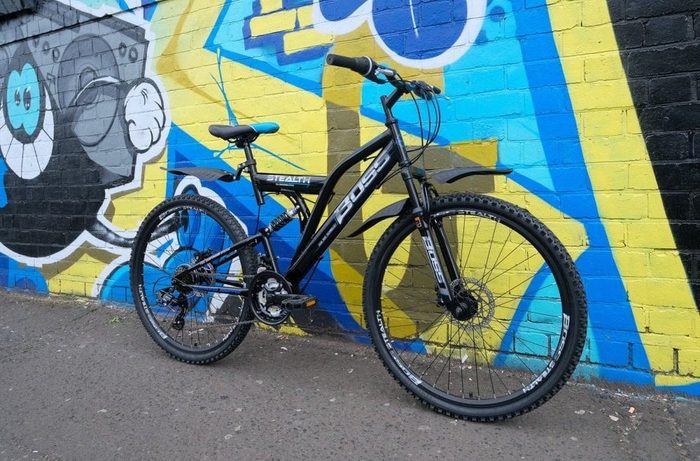
Note: Entry-level full-suspension bikes are available under £250 (particularly in junior ranges like the Boss Stealth 24, where rear springs add comfort on bumpy park paths). For an adult rider going on serious off-road trails, though, you’re generally better off with a decent hardtail at that price point.
Frame Materials: 6061 Aluminium Alloy vs Hi-Tensile Steel
- 6061 Aluminium Alloy: The go-to for the hobbyist mountain bike. It’s rust-resistant, stiff enough for responsive steering, and lighter to lift onto a car rack or pedal up a steep hill.
- Hi-Tensile Steel: The go-to for budget rec bikes and durable kids’ bikes. It’s absolutely robust, does a great job of damping out trail vibration and is virtually indestructible. The downside is that it’s much heavier than alloy (adds roughly 1.5kg to 2.5kg to the total bike weight).
Mountain Bike Sizing, Wheel Sizes, and Junior Bikes
The right mountain bike size is determined by rider height and inside leg measurement, not age. Adult mountain bikes will generally be 26″, 27.5″ or 29″ wheels with frames sized in inches or small to large. For the younger rider, there are dedicated junior bikes with 20″ or 24″ wheels and appropriately scaled down frames, shorter crank arms and easy reach brakes to build confidence when riding off-road.
A badly fitted bike can lead to sore wrists, lower back pain, and shaky cornering. Use your inside leg measurement (measured from the floor to your crotch in bare feet, standing up against the wall) in conjunction with your total height to select the correct frame.
Adult Mountain Bike Size Guide
| Rider Height | Inside Leg Measurement | Recommended Frame Size | Typical Wheel Size |
| 5’0″ to 5’4″ (152cm to 163cm) | 26″ to 28″ (66cm to 71cm) | 14″ (Extra Small / Small) | 26″ or 27.5″ |
| 5’4″ to 5’8″ (163cm to 173cm) | 28″ to 30″ (71cm to 76cm) | 16″ (Small / Medium) | 26″ or 27.5″ |
| 5’8″ to 6’0″ (173cm to 183cm) | 30″ to 32″ (76cm to 81cm) | 18″ (Medium / Large) | 27.5″ or 29″ |
| 6’0″ to 6’3″ (183cm to 191cm) | 32″ to 34″ (81cm to 86cm) | 20″ (Large / Extra Large) | 27.5″ or 29″ |
Choosing a Wheel Size:
- 26-inch wheels: agile, quick to accelerate and low to the ground, ideal for the shorter adult, the teenager and the recreational rider.
- 27.5-inch wheels: the middle-ground standard, offering nimble handling and smooth rolling over roots and gravel.
- 29-inch wheels: roll over rough terrain effortlessly and maintain speed very well on long cross-country rides, just feel a bit taller on smaller riders (under 5’6″).
Buying Junior Mountain Bikes: What Parents Should Look For
It’s tempting to go for an oversized adult bike so a child can “grow into it”, but the heavy frame and wide handlebars make it hard for a young rider to steer and brake safely. A genuine junior mountain bike is designed to scale every aspect to suit the smaller rider.
- 20″ Wheel Junior Bikes (Ages 6 to 9, Height 113cm to 135cm): The Boss Stealth 20″ Mountain Bike, for instance, is a 6-speed Shimano with simple twist-grip shifters so the kid can concentrate on steering rather than the complicated front chainrings.
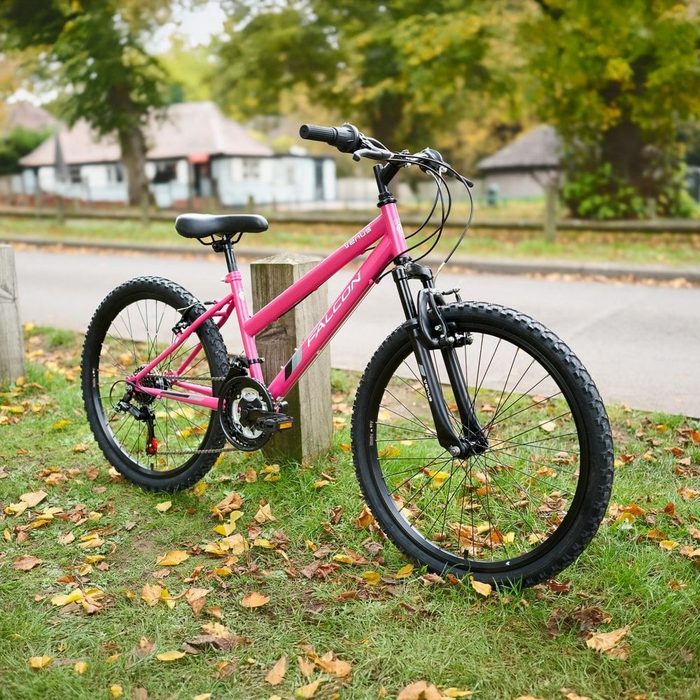
- 24″ Wheel Junior Bikes (Ages 8 to 12, Height 127cm to 147cm): The Boss Stealth 24″ Mountain Bike and the Falcon Neutron 24″ are the sorts of bikes that effectively bridge the gap between a kids’ bike and an adult frame. They come with mechanical disc brakes and 18-speed gearing, so you can properly get your kids on the trail.
- 26″ Compact Youth Frames (Ages 11+, Height 145cm+): Once a teen is over 145cm, they’re ideally suited to a 14″ frame with 26″ wheels (the smaller frame option on the Claud Butler Edge HT, for example), which gives them an adult-capable bike with lots of seatpost adjustment to cope with growth spurts.
Adjustability and Comfort: How to Raise Handlebars on a Mountain Bike
Mountain bikes are highly adjustable to suit your riding posture and terrain. You can adjust saddle height, tilt the brake levers, and raise the bar for a more upright, back-friendly riding position. It takes ten minutes to learn how to raise the bars on a mountain bike with nothing more than a pair of basic Allen keys. You simply move the headset spacers underneath a threadless stem, fit a high-rise handlebar or raise a traditional quill stem.
Many beginners think a mountain bike has to be all stretched out and uncomfortable. In reality, a bit of cockpit fiddling makes a massive difference to how the bike handles. Before you even get to the bars, set your saddle height so that when the pedal is at its lowest point, your knee has a very slight bend (around 25 to 30 degrees). If your wrists or lower back still feel strained, follow the steps below based on your stem type.
Method 1: Raising Threadless Aheadset Handlebars (Modern Stems)
Most modern alloy mountain bikes use a threadless headset, with the stem clamping onto the fork’s steerer tube.
- Look for spacers above the stem: Check the top cap of your stem. If thin black or silver rings (headset spacers) are stacked above the stem, then simply move them underneath to gain 5mm to 20mm of extra height.
- Loosen the top cap bolt: Use a 5mm Allen key to unscrew the central top cap bolt fully, then set the cap to one side.
- Loosen the stem pinch bolts (the two horizontal bolts on the side of the stem clamp) until the stem slides freely on the steerer tube.
- Reposition the spacers: Remove the stem from the tube, move the spacers from above the stem to below it and reinsert the stem onto the tube.
- Preload the headset bearings: Refit the top cap and tighten the top bolt gently until there is no rocking play when you hold the front brake and rock the bike back and forth (do not overtighten, or steering will feel stiff).
- Align and tighten: Line up the stem straight with your front tyre, then tighten the two side pinch bolts evenly to the manufacturer’s torque specification (usually 5Nm to 6Nm).
Tip: If all your spacers are already below your stem, swap your flat handlebar for a riser handlebar (30mm to 50mm of rise) or fit an angled stem extender.
Method 2: Raising a Threaded Quill Stem (Classic Entry-Level Stems)
Some of the more entry-level leisure mountain bikes (e.g. the Falcon Maverick) use a single-piece L-shaped quill stem which goes in the fork tube:
- Loosen the central expander bolt: Use an Allen key (usually 6mm) to turn the vertical bolt at the top of the stem anti-clockwise by three or four full turns.
- Release the internal wedge: If the stem does not move immediately, tap the top of the loosened bolt lightly with a rubber mallet to free the wedge inside the fork.
- Raise the stem safely: Pull the handlebars up to your desired height, ensuring the “Minimum Insertion” mark etched on the stem shaft stays completely hidden inside the frame.
- Tighten securely: Align the handlebars straight with the front wheel and tighten the top bolt firmly so the bars cannot twist under hard braking.
What Is the Best Mountain Bike for Beginners? Top Picks by Riding Style
The best mountain bike for a beginner is a solid hardtail with an aluminium frame, 18-24 speeds, and good brakes. You don’t need complex downhill suspension, so a versatile bike that handles local trails and cycle paths is the way to go. The Claud Butler Edge HT is a good all-rounder for trail riding, the Boss Black Ice is a good-value option and offers all-round trail durability, and the Boss Stealth 24 is for juniors.
Rather than declaring a single universal winner, the right choice is based on your budget, fitness goals, and local terrain. Exploring our mountain bike collection highlights how different specifications meet distinct hobbyist needs:
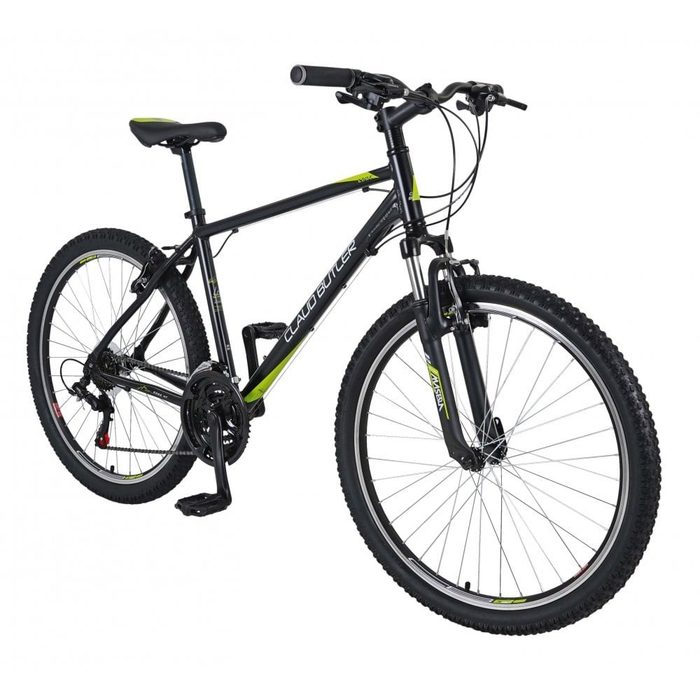
1. Best All-Round Beginner Hardtail: Claud Butler Edge HT
- Best for: Hobbyists looking for a light, traditional hardtail for forest trails, gravel, and fitness rides.
- Main Features: Built around a durable 6061 alloy MTB frame weighing just 14kg, the Claud Butler Edge HT Mountain Bike pairs a 50mm Zoom suspension fork with 18-speed Shimano EZ-Fire trigger shifters and double-wall alloy rims. Available in 14″, 16″, 18″, and 20″ frame sizes, it scales cleanly from teenagers to tall adults.
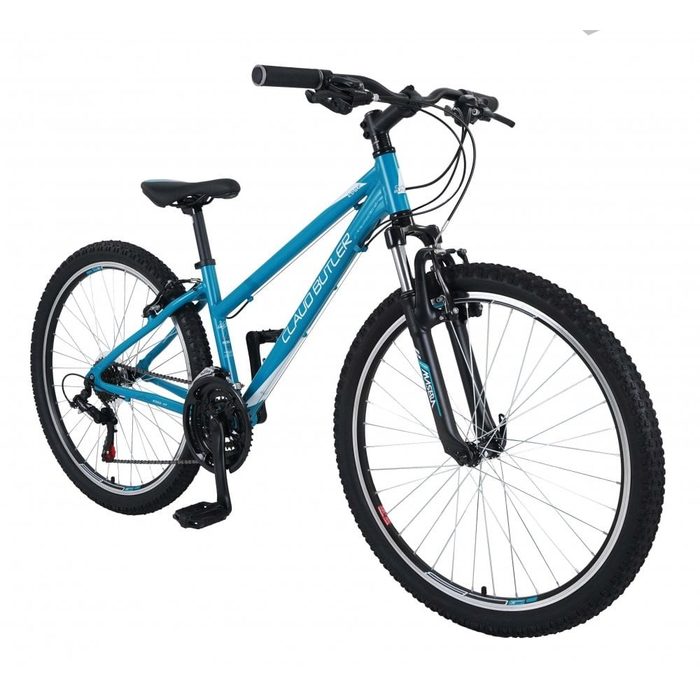
2. Best Accessible Step-Through MTB: Claud Butler Edge HT Low Step
- Best for: Riders who want easy mounting and dismounting without sacrificing off-road capability.
- Main Features: Featuring a lowered top tube for effortless stepping on and off, the Claud Butler Edge HT Low Step retains the same lightweight 6061 aluminium frame, front suspension fork, and Shimano gearing as the standard Edge HT, making it excellent for canal towpaths, country parks, and riders with limited hip mobility.
3. Best Value Trail & Commuter MTB: Boss Black Ice
- Best for: Budget-conscious beginners who want disc brakes and mudguards included.
- Main Features: Designed for riders from 5’2″ to 6’0″ (157cm to 183cm), the Boss Black Ice Mountain Bike upgrades stopping power with front and rear mechanical disc brakes (which outperform rim brakes in wet UK mud), 18-speed Shimano gearing, and factory-fitted mudguards.
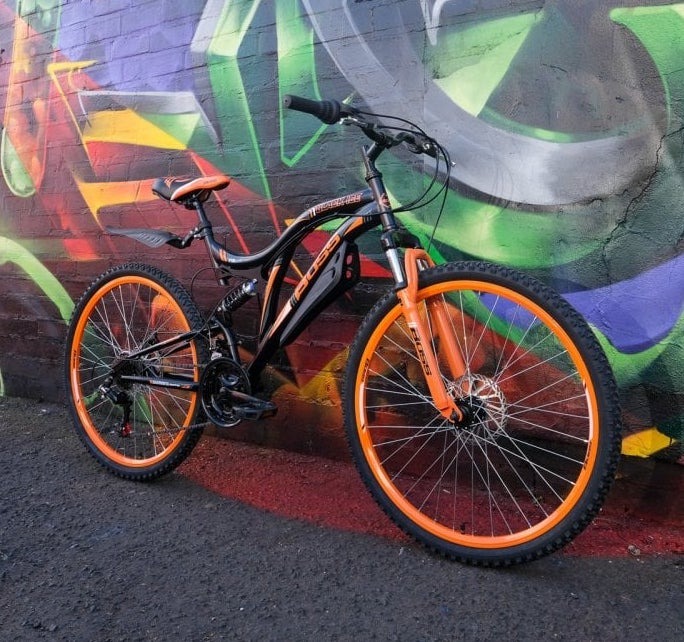
4. Best Multi-Surface Leisure Bike: Falcon Maverick
- Best for: The casual weekend rider who’ll be splitting their time between tarmac cycle lanes and dry woodland paths.
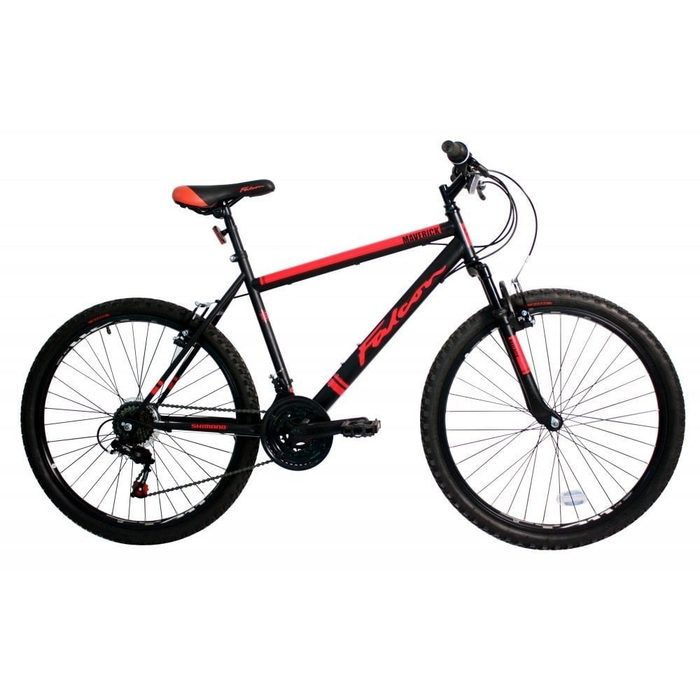
- Main Features: With a tough hi-tensile steel frame, front suspension fork, and 26″ x 1.95″ multi-purpose tyres, the Falcon Maverick Mountain Bike rolls smoothly on paved cycle routes while still soaking up bumps on park bridleways.
5. Best Electric Mountain Bike for Steep Hills: Claud Butler Ridge 1.0 e-MTB
- Best for: Beginners returning to fitness, riders on hilly terrain or commuters who want to tackle hills without sweating.
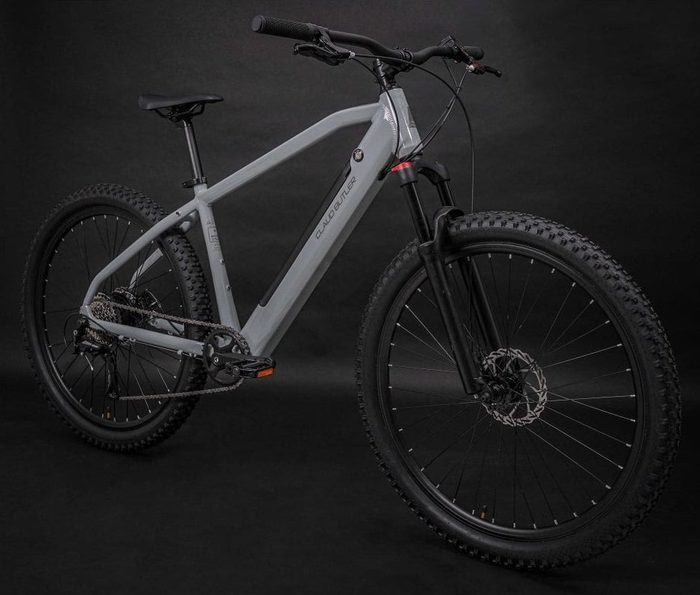
- Main Features: Powered by a Bafang rear hub motor and an integrated 375Wh removable battery offering up to 40 miles (64km) of assistance, the Claud Butler Ridge 1.0 Electric Mountain Bike combines 27.5″ x 2.35″ trail tyres with a 120mm lockout suspension fork to flatten steep climbs.
6. Best Junior Mountain Bike: Boss Stealth 24 Inch
- Best for: Young off-roaders aged 8 to 12 (height 4’2″ to 4’10” / 127cm to 147cm) ready for real off-road riding.
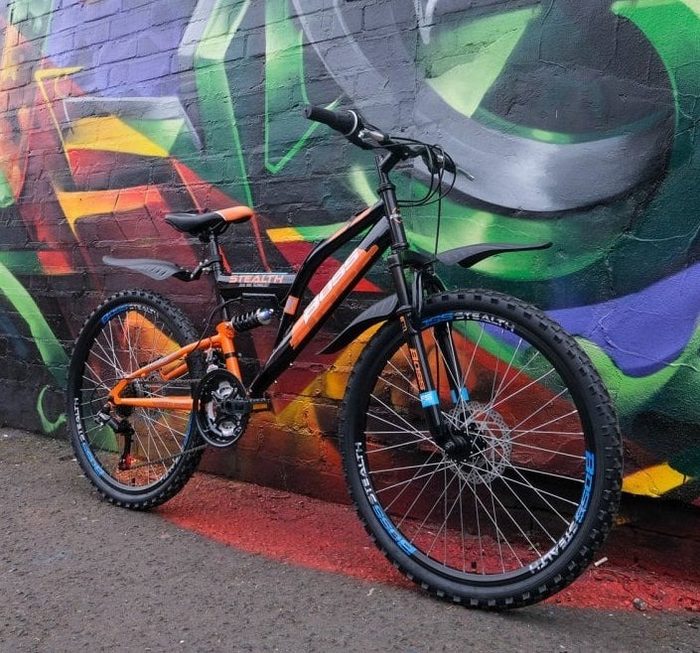
- Main Features: With mechanical disc brakes, an 18-speed Shimano rear derailleur with intuitive twist-grip shifting, front and rear suspension, and full mudguards, the Boss Stealth 24 Inch Mountain Bike gives junior riders real trail control.
Essential Bike Care: How to Clean a Mountain Bike After a Muddy Ride
Knowing how to clean your mountain bike properly helps prevent premature chain wear, rust, and noisy brakes after a wet UK trail session. Give the bike a gentle rinse with a low-pressure hose or bucket to remove loose mud. Apply bike cleaner and degreaser to the drivetrain, scrub with soft brushes, rinse, dry with a microfibre cloth, and apply fresh chain lube. Keep oil well away from the brake discs and rims.
Leaving wet grit on your chain and suspension stanchions is like liquid sandpaper. Do the following 6-step routine within a few hours of a muddy ride:
- Pre-rinse with low pressure: Use a standard garden hose on a gentle shower setting, or a bucket and sponge, to knock off heavy clumps of mud. Avoid high-pressure jet washes, as they can force water past the rubber seals into the wheel hubs, bottom brackets, and suspension forks.
- Degrease the drivetrain: Spray a cycling-specific degreaser onto the chain, rear cassette and front chainrings. Let it soak for 2-3 minutes, then work the grime loose with a stiff nylon brush or an old toothbrush while pedalling backwards.
- Wash the frame and wheels: Spray a biodegradable bike wash on the frame, saddle and tyres. Use a soft sponge on the frame and a separate brush on the dirty tyres and wheel rims to avoid any grit scratching your paintwork.
- Rinse thoroughly: Hose the whole bike from top to bottom until all suds and degreaser are gone.
- Dry all metal surfaces: Give the bike a light bounce on the tyres to remove excess water, then wipe the frame, suspension fork stanchions, and chain dry with a clean microfibre cloth.
- Lubricate the chain (and wipe excess): Apply one drop of wet lube (for rainy winter rides) or dry lube (for dusty summer trails) to each chain link whilst turning the pedals backwards. Wait two minutes, then wipe off any excess oil with a clean rag by spinning the pedals.
Important safety check: don’t let any chain lube or silicone frame spray contact your brake discs or wheel rim braking surfaces, as it will destroy braking power and cause very loud squealing.
Frequently Asked Questions (FAQs)
What’s the best mountain bike budget for a beginner?
For a reliable beginner hardtail in the UK, expect to spend between £200 and £450. Bikes in this bracket offer durable aluminium or steel frames, dependable Shimano gearing, and front suspension forks that can handle forest tracks, towpaths, and Green or Blue trail centre routes, with minimal maintenance.
Can you ride a mountain bike on the road?
You can absolutely ride a mountain bike on tarmac roads and on paved cycle paths. The wide, knobbly tyres will have a bit more rolling resistance than smooth road tyres, but if you inflate them to the higher end of their recommended PSI range (40 to 50 PSI), the speed difference on the road is quite noticeable.
How often should you clean and lubricate a mountain bike chain?
Clean and re-lube your mountain bike chain after every wet or muddy ride, or roughly every 100 miles (160km) in dry summer conditions. Keeping the chain clean prevents gritty paste from building up and grinding down your cassette teeth, and it goes a long way toward extending your drivetrain’s life.
What’s the difference between mechanical disc brakes and V-brakes?
V-brakes (linear-pull rim brakes) clamp rubber pads directly onto the outer wheel rim; they are lightweight, inexpensive, and easy to adjust on dry leisure rides. Mechanical disc brakes use a cable-actuated calliper to squeeze pads against a metal rotor attached to the wheel hub, delivering more consistent stopping power in wet mud and puddle-filled trails.
Mountain Bikes at Jack Stonehouse
Choosing your first mountain bike comes down to choosing the right frame and wheel size for the trails you actually want to ride. Start with a well-fitted hardtail mountain bike for the best combination of value, climbing efficiency, and low maintenance; make sure younger family members ride properly scaled junior bikes rather than oversized adult frames; and take ten minutes to dial in your handlebar height and saddle position before your first outing.
Ready to hit the trails? Explore our mountain bike collection for a full range of adult hardtails, electric mountain bikes, and junior models, and find the ideal ride for your next outdoor adventure.
Read Next
Electric Bike vs Regular Bike: Which One’s Right for You?
Electric Bikes in the UK: How They Work, What the Law Says & What to Expect
The Only Bike You’ll Ever Need? Why Hybrid Bikes Are Taking Over
Comments are closed here.