
Are Electric Patio Heaters Expensive to Run? (UK Garden Energy Guide)
Heating your garden on chilly British evenings often raises concerns about rising electricity bills. With energy prices at the forefront of everyone’s mind, many homeowners worry that turning on an outdoor heater will cause their electricity bills to skyrocket.
The good news is that modern electric patio heaters, particularly infrared models, are far more efficient than many people realise. This guide breaks down the exact hourly running costs of electric patio heaters in the UK, compares them directly against gas and wood-burning alternatives, and helps you choose the right heating setup for your specific garden layout.
Summary
- Average Hourly Cost: Running a standard 2kW electric patio heater in the UK costs approximately 52p per hour on full power (based on an average electricity tariff of 26p per kWh).
- High Efficiency: Electric infrared heaters convert over 90% of their energy directly into radiant heat, warming people and surfaces rather than wasting energy heating moving air.
- Cheaper Than Bottled Gas: Electric heaters cost less than a third of the hourly cost of running a standard bottled-gas patio heater.
- Layout Matters: Compact balconies benefit from space-saving hanging or wall-mounted electric heaters, open patios suit 360-degree fire baskets, and windy gardens perform best with chimineas.
Content
How Much Does an Electric Patio Heater Cost to Run Per Hour in the UK?
Under typical UK electricity tariffs of approximately 26p per kWh, a standard 2kW electric patio heater costs roughly 52p per hour to run on full power. Smaller 1.5kW units cost around 39p per hour, while heavy-duty 3kW heaters cost around 78p per hour. Because infrared models provide immediate warmth without heating air currents, they remain one of the most cost-effective outdoor heating options available.
Calculating the exact running cost of an electric patio heater requires a simple formula: multiply the unit’s power rating (in kilowatts) by your supplier’s electricity rate (in pence per kilowatt-hour).
To help you budget, the table below illustrates typical running costs across common wattage ratings, based on a standard UK electricity rate of 26p per kWh.
| Heater Wattage (kW) | Cost Per Hour (100% Power) | Cost for 3 Hours | Cost for 5 Hours |
| 1.5 kW (Compact Wall/Hanging) | 39p | £1.17 | £1.95 |
| 2.0 kW (Standard Freestanding) | 52p | £1.56 | £2.60 |
| 2.5 kW (Large Area Infrared) | 65p | £1.95 | £3.25 |
| 3.0 kW (Commercial / Dual Element) | 78p | £2.34 | £3.90 |
Unlike indoor convection radiators that heat the air over several hours, electric infrared patio heaters deliver full heat output within seconds of being switched on. This means you pay only for the time you spend sitting outside.
Electric vs Gas Patio Heaters: Which Is Cheaper?
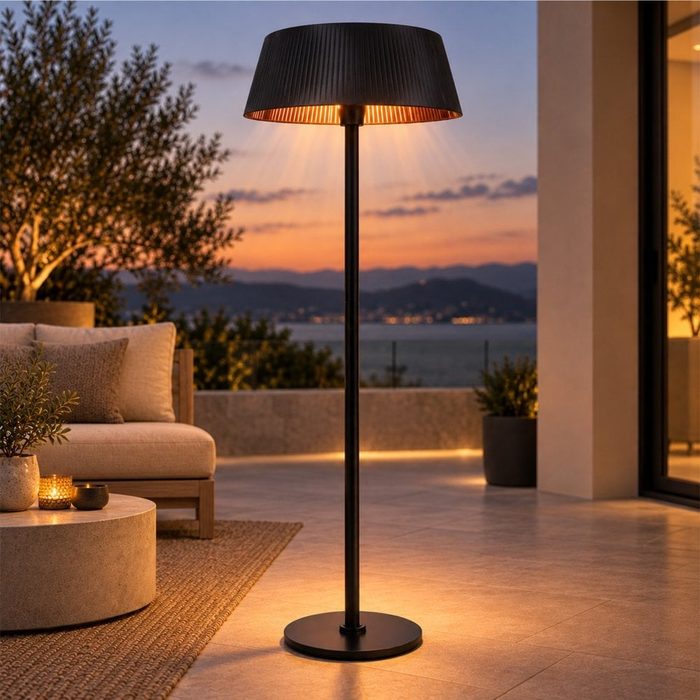
Electric patio heaters are significantly cheaper to operate and more energy-efficient than bottled-gas patio heaters. While a 2kW electric heater costs around 52p per hour, a standard 13kW patio gas heater costs between £1.80 and £2.50 per hour in patio gas refills. Furthermore, electric infrared models convert over 90% of their energy directly into radiant heat, whereas gas heaters lose a significant portion of their thermal energy to the ambient air.
The primary difference between electric and gas outdoor heating lies in how heat is transferred:
- Convection Heat (Gas): Gas patio heaters warm the surrounding air. In an outdoor environment, warmed air rises quickly and is blown away by even a light breeze, so they require high wattage (up to 13kW) to maintain a noticeable temperature rise.
- Radiant Heat (Electric Infrared): Electric infrared heaters emit electromagnetic waves that travel through the air without heating it, directly warming human skin, clothes, and furniture.
Because radiant heat isn’t lost to wind drift, an electric heater needs a fraction of the power of a gas burner to deliver the same comfort to you and your guests, saving you money every autumn evening.
Matching Your Heating Setup to Your Garden Layout
Selecting the right heater depends heavily on your garden’s size and wind exposure. Small urban courtyards and balconies often need overhead, wall-mounted or hanging electric heaters to save floor space. Spacious central patios suit open 360-degree fire baskets for gathering large groups. Meanwhile, exposed or windy gardens benefit most from chimineas, as built-in flues route smoke upwards away from guests while maintaining ambient warmth.
Choosing an outdoor heater involves more than wattage. To get the maximum heat output for every penny spent, match your heating setup to your garden’s layout.
Small Urban Courtyards and Balconies: Hanging & Wall-Mounted Electric Heaters
Floor space is at a premium in compact townhouses, balconies, and small courtyards. A bulky floor heater in a small area creates trip hazards and limits seating arrangements.
- Best Choice: Space-saving wall-mounted electric heaters or overhead hanging patio heaters.
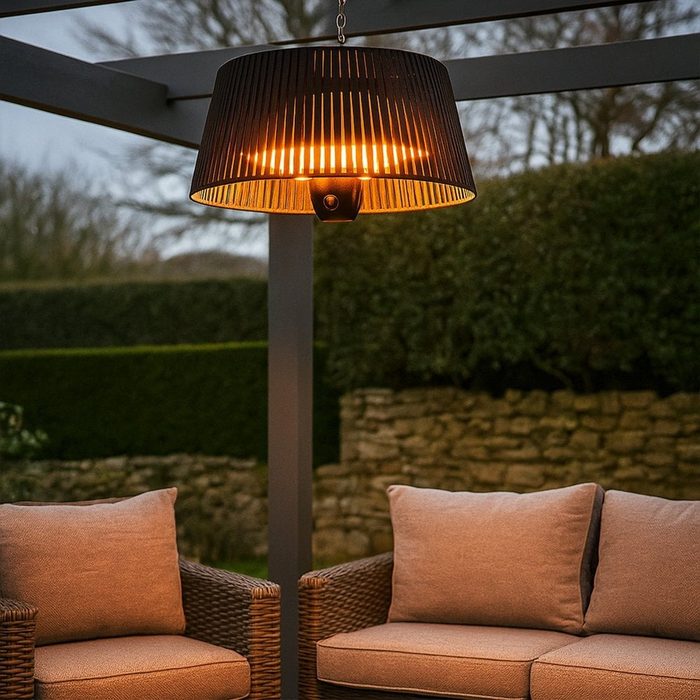
- Why it Works: Mounting your heater on a brick wall or hanging it from a gazebo canopy directs radiant heat downward over your seating zone without taking up a single square inch of floor space.
- Explore our curated range of hanging patio heaters and wall-mounted patio heaters to optimise space in small gardens.
Open Patios and Family Hosting: 360-Degree Fire Baskets
When hosting larger family gatherings or garden barbecues where guests sit in a full circle, directional electric heaters mounted on one side can leave some people feeling left out in the cold.
- Best Choice: Open fire baskets and wood-burning fire pits.
- Why it Works: Fire baskets cast natural warmth and light in a full 360-degree radius, creating an atmospheric focal point that comfortably accommodates larger groups.
- Browse our selection of heavy-duty fire baskets and fire pits for atmospheric outdoor hosting.
Windy or Exposed Gardens: Chimineas for Wind Resistance
Open, breezy gardens present a double challenge: wind quickly dissipates warm air, and traditional open fires tend to blow smoke directly into your eyes or your guests’.
- Best Choice: Traditional cast iron or clay chimineas.
- Why it Works: A chiminea encloses its fire inside a solid burning belly, protecting the flames from gusts of wind. Its tall, integrated flue creates a natural draft that draws smoke up and away from seating level, keeping your patio cosy and smoke-free.
- Discover long-lasting cast iron chimineas engineered for sheltered, smoke-free outdoor heating.
Flexible Garden Spaces: Freestanding Electric Patio Heaters
If your garden features multiple seating areas (such as a dining table on the main patio and lounge chairs at the bottom of the lawn), fixed wall mounts may not offer enough versatility.
- Best Choice: Portable freestanding electric patio heaters.
- Why it Works: Featuring weighted bases and height-adjustable stands, freestanding electric models can be easily wheeled or carried to wherever you need targeted, plug-and-play warmth.
- Check out versatile freestanding electric patio heaters for portable heating across your entire garden.
Simple Tips to Lower Your Outdoor Heating Bills
To reduce electric patio heater running costs, choose directional infrared models with variable heat settings and automatic timers. Position heaters close to seating areas under pergolas or near windbreaks to reduce heat loss. Using lower power settings once ambient warmth is established further conserves energy, ensuring you pay only for the heat you actually feel, without wasting electricity on space.
You can easily keep your outdoor energy consumption low by implementing a few practical setup habits:
- Lower the Power Output: Look for units with multiple heat settings (e.g., 650W / 1350W / 2000W). Start at full power to warm the area quickly, then switch down to a lower setting to maintain comfort.
- Position Heaters Correctly: Mount or place your heater between 2.1 metres and 2.4 metres high, angled downward at a 45-degree angle toward your main seating area.
- Block the Wind: Position your seating against fences, garden walls, or beneath pergolas equipped with side panels. Reducing wind chill allows you to run your heater on a lower setting.
- Choose Carbon Infrared Elements: Carbon infrared lamps produce medium-wave heat that feels softer on the skin and penetrates wind more effectively than traditional halogen bulbs, offering superior comfort per watt used.
Frequently Asked Questions (FAQs)
Can you leave an electric patio heater on overnight?
No, you should never leave an electric patio heater running unattended overnight. Although modern outdoor heaters feature thermal safety cut-offs and waterproof IP ratings (such as IP65), operating electrical heating elements without supervision presents unnecessary fire risks and wastes electricity. Always switch off and unplug your heaters from the mains when outdoor areas are unoccupied.
Are carbon electric patio heaters cheaper to run than halogen heaters?
Carbon electric patio heaters are generally more cost-effective in terms of perceived warmth. While a 2kW carbon heater consumes the same amount of electricity as a 2kW halogen heater, carbon elements emit medium-wave infrared heat. This soft heat penetrates human skin more deeply and is less prone to blowing away in breezes than the short-wave heat produced by halogen lamps, allowing you to use lower power settings for equal comfort.
Do electric patio heaters use a lot of electricity compared to indoor appliances?
Electric patio heaters draw as much electrical power as standard high-draw indoor appliances. For comparison, a 2kW patio heater uses the same power output as a standard domestic fan heater or an electric kettle while boiling. Running a 2kW patio heater for two hours uses 4kWh of electricity, roughly equivalent to running a standard tumble dryer load.
Finding the Ideal Heating Setup for Your Garden
Electric patio heaters offer a clean, instant, and manageable way to extend your outdoor living season into autumn and early spring. At around 52p per hour for a standard 2kW unit, they provide direct heat where you need it without the expensive refill costs of patio gas.
Whether you need a space-saving wall heater for an urban balcony, a smoke-channelling chiminea for a windy terrace, or a roaring fire basket for large gatherings, choosing the right heating style for your garden layout makes all the difference to both comfort and running costs.
With the right electric patio heater, you can comfortably enjoy your garden long after the summer sun sets. Explore the complete collection of outdoor heating, fire pits, and garden essentials at Jack Stonehouse today.
Read Next
Why should I buy an oil-filled radiator?
A buyer’s guide to energy-efficient portable heaters
Oil-Filled Radiator vs Electric Heater: Your Complete Winter Warming Guide
Comments are closed here.